

Actors embedded in covert networks are often confronted with a dilemma. Communication is necessary for working with others, furthering group cohesiveness and boosting morale. At the same time, the digital traces of such exchanges — whether carried out via cellular or satellite phones, or some other, newer, method — can be exploited by those tasked with combatting covert actors, leading to possible detection and eventual removal through arrests or worse. Insurgents, terrorists, and organised criminals have to thus delicately balance organisational imperatives with continued survival.
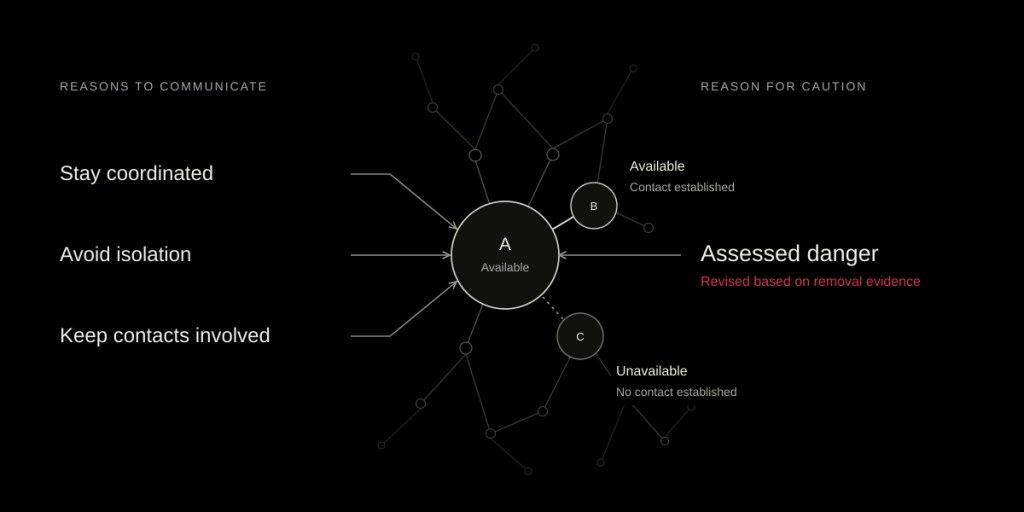
Naturally, a covert actor is capable of learning from their environment, and updates their beliefs about the dangers of communication time to time based on information about those in their vicinity. Actors can also drop out of the network if they are left isolated through lack of contact. In conjunction with actions by counteractors — for example, surveillance-based detection and detention by security services — these features create feedback loops.
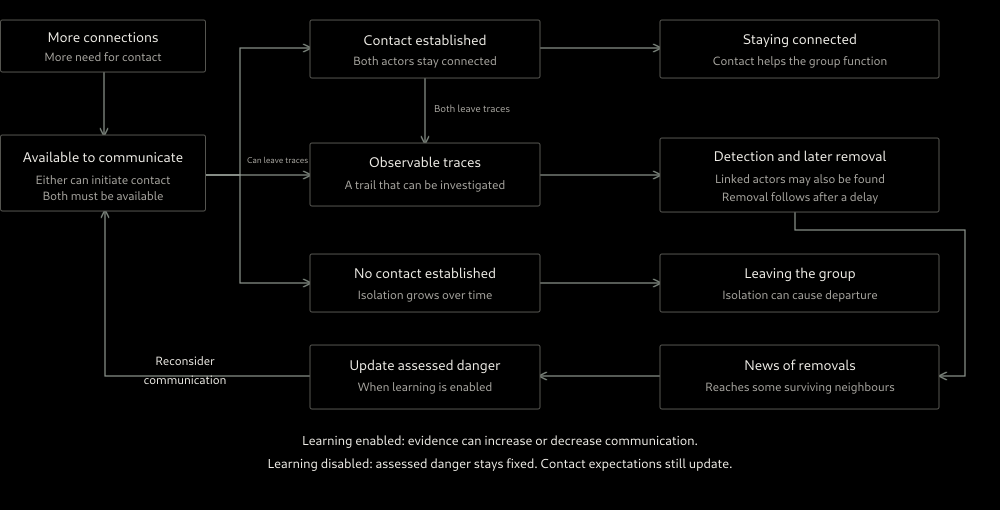
One immediate consequence of these systemic effects is that the total number of active actors in the network can be quite different from those visibly active — in other words, those who leave digital traces, whether detected or not.
Plainly put, electronic footprint from communication is far from being a useful proxy in estimating the numerical strength of a covert organisation at any given point in time. The degree to which it is useful crucially depends on extant actor beliefs and bases of inferences, all of which are a priori unknown to the counteractor.
We invite you to experiment with such conditions and explore the resulting dynamics in the interactive agent-based model below.
Related literature
Our model is not built from any single framework. However, trade-offs in covert networks have been explored extensively in the security studies literature. Some of these works have influenced our treatment: Shapiro’s 2013 book is an authoritative reference on the organisation of terrorist groups and ensuing principal-agent problems. van Elteren, Vasconcelos, and Lees use evolutionary game theory to study how criminal networks form and respond to counteractor interventions. Like them, Morselli, Giguère, and Petit also explore tradeoffs between efficiency and security, while Lindelauf, Borm, and Hamers look at the relationship between secrecy and communication, using optimisation and bargaining theories. For broader technical discussions of mathematical and computational problems in the study of covert networks, see this special issue of Lincoln Laboratory Journal.
The simulation
Choose your settings to explore. Expand Help for an explanation of each parameter. Do look at Starting conditions, Actor behaviour and Additional settings for a much longer list of choices.
Methods
The network in this model is modular with loosely connected communities. Actors differ in how many connections they have, but are otherwise unlabelled. They make decisions to communicate probabilistically. In the learning mode, they update their beliefs using Bayesian inference, based on delayed and imperfect knowledge about removal of neighbours by counteractors.
The model was created using Python 3 and the NumPy and Matplotlib libraries. Gunicorn served the application hosted on Render.
Tarqeq uses generative artificial intelligence models for research. Our AI policy for various products, publications and pages is available here.
The simulation model presented here was conceptualised and designed by Tarqeq. OpenAI’s GPT-6.1 Sol assisted with mathematical formulation, computational implementation, graphics, and literature review.
Discover more from Tarqeq Research
Subscribe to get the latest posts sent to your email.