
The recent wave of civil unrest across the world, including youth-led protests in the Indian subcontinent, has once again thrown questions around the interaction of networked influence, information propagation through conventional and social media, flashpoints such as arrests and other symbolically charged events, policy responses, and mass mobilisation into sharp relief. Motivated by the need to have better computational tools to examine them, we recently released INQLAB, a simulator that allows analysts to experiment with various pertinent parameters and scenarios and explore possible outcomes (see the tool’s User Guide for a detailed introduction). As such, we see INQLAB as also serving as a decision support tool for policymakers.
The INQLAB model
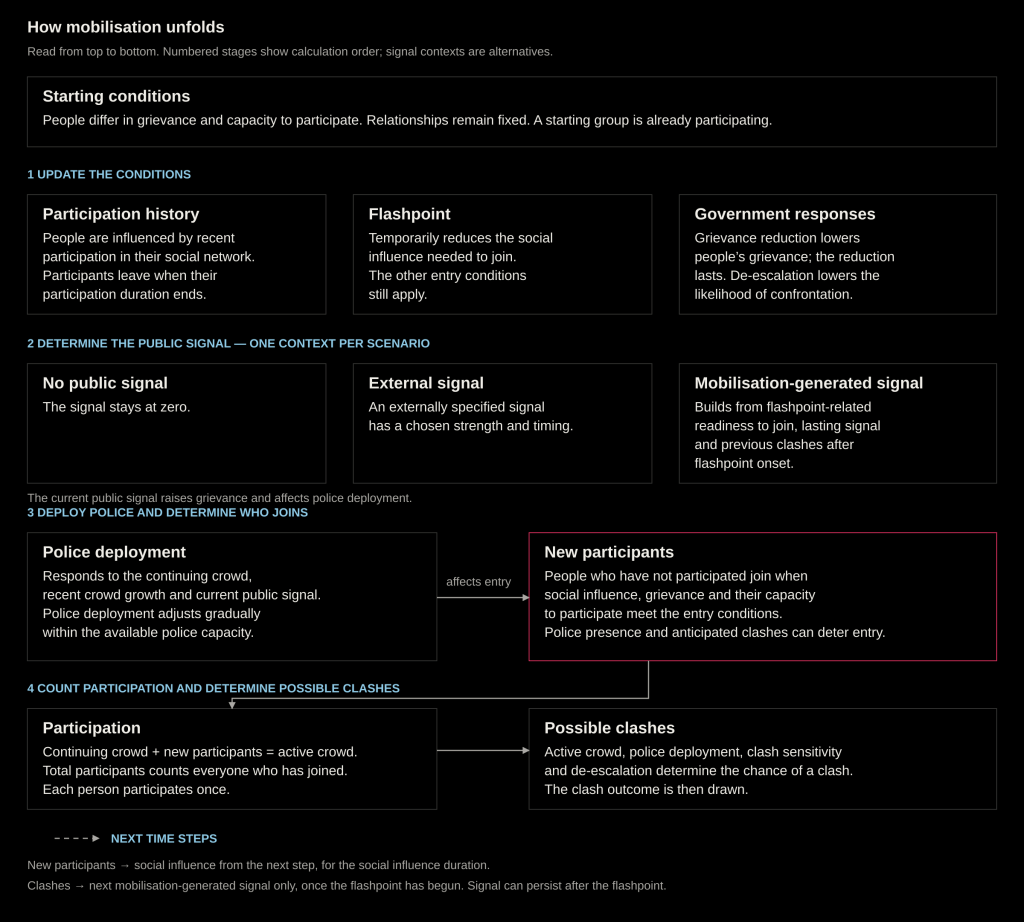
For a policymaker, the key question in the face of public mobilisation is that of mitigation. To wit, a government official is likely to be interested in what measures they can deploy — and in what combination — to minimise cumulative participation and/or peak crowd size. They may also want to look for responses that result in fewer clashes between protestors and authorities and require less police deployment.
While INQLAB allows policymakers to explore all of these questions and more, it does so by showing how one set of assumptions — including government responses — would unfold over time. But comparing many runs simultaneously lets us examine how different combinations of responses affect the outcomes.
The following explorer looks at the combined effects of two key government responses: the strategic (and political) response of grievance reduction, and the tactical de-escalation response. It allows the interested analyst to examine the following questions: Where and when do adjacent response combinations produce similar outcomes? Where does a small change in a given response result in a large change in the outcome? When are responses most potent: during a flashpoint, or later? What if there is no information-bearing public signal that contributes to mobilisation? Most importantly, how are the responses to be combined to obtain the desired outcome? And what are the tradeoffs involved?
Do note that the explorer is interactive: rotate the landscape to inspect its shape, and select a sampled position to examine the outcomes across twenty runs. Switch between an individual run and the average, and inspect the accompanying history over time. Consult the Details tab to learn more.
Tarqeq uses generative artificial intelligence models. Our AI policy for various products, publications and pages is available here.
The explorer above was built by OpenAI Codex based on precomputed INQLAB cases, under extensive human guidance.
Discover more from Tarqeq Research
Subscribe to get the latest posts sent to your email.